
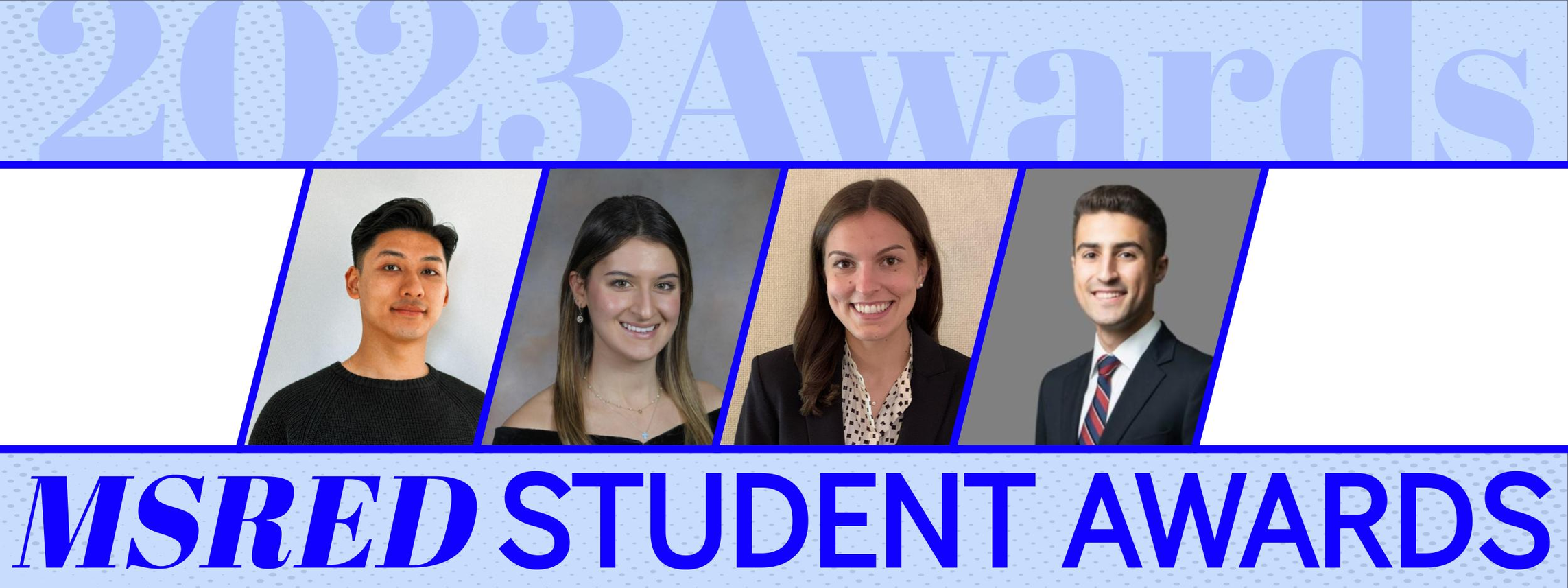
2023 Student Award Recipients
In 2023, the MSRED Alumni Inc. launched the inaugural MSRED Student Awards scholarship, an opportunity for current students to showcase their academic achievements, highlight lessons learned from their time in the program, and convey their unique commitment to contributing to the industry as alumni. We are excited to spotlight the four recipients of the 2023 Student Awards!
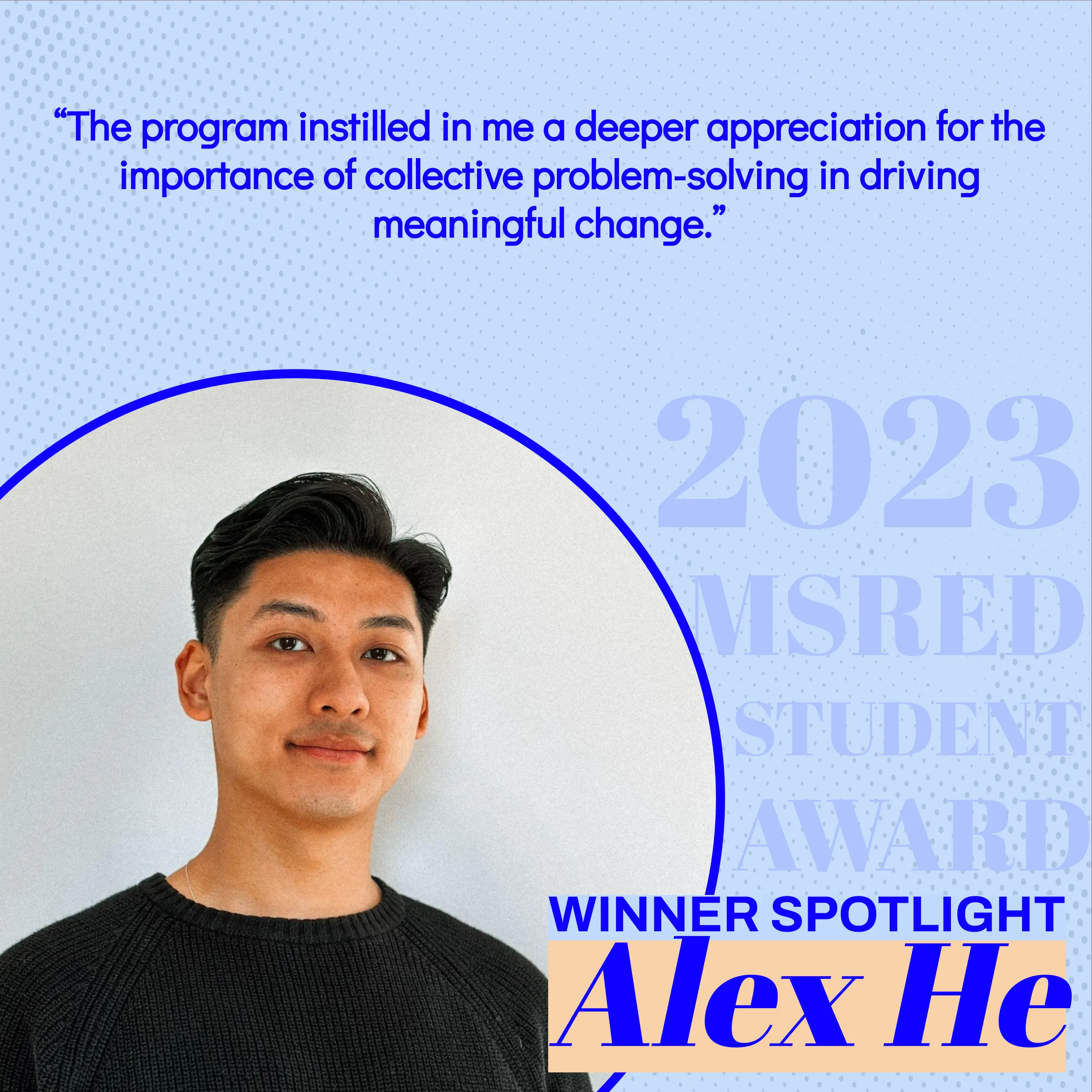
Alex He
Degrees: Master of Architecture and Master of Science in Real Estate Development
Graduation Date: December 2023
1. Reflecting on your time in the MSRED program thus far, what are the key lessons or experiences that have had a lasting impact on your professional and/or personal growth?
Reflecting on my journey within the MSRED program, the most transformative experiences stem from the rich connections and interactions I have had with my peers. These relationships have not only shaped the program's culture into a vibrant community of critical thinkers but have also profoundly influenced my professional and personal growth. Engaging with individuals who are equally passionate about questioning and reshaping the world of real estate has expanded my perspectives and deepened my understanding of the field. The lessons learned from these interactions have been as invaluable as the formal education provided by the program, instilling in me a deeper appreciation for the importance of collective problem-solving in driving meaningful change.
2. What academic areas of focus have you explored while in the MSRED program? Have these led to a greater understanding of your future professional goals?
In the MSRED program at GSAPP, my academic journey has had a heavy focus on inclusive sustainable developments through the revitalization of underutilized land stemming from my personal experience with gentrification in San Francisco's Mission district. Engaging in research projects, like "WasteLand" in conjunction with Director Patrice Derrington, has deepened my understanding of transforming disused spaces into community assets, reinforcing my dedication to equitable and responsible real estate development. These endeavors have not only honed my skills in identifying opportunities for inclusive urban growth but also clarified my professional aspirations. My studies have laid a solid foundation for a career aimed at innovating real estate practices that prioritize environmental sustainability, illustrating a direct path from academic exploration to future professional objectives.
3. How do you plan to utilize your time in the MSRED program to contribute to the world, post-graduation?
Post-graduation, I aim to apply my dual expertise in architecture and real estate development to pioneer novel development models that address climate resilience, and the inequality gap. Supported by MSRED Alumni Inc., I intend to continue bridging academic research with industry practice, advocating for conscientious developmental practices that contribute meaningfully towards equitable development.
4. What is a core memory from your time in the MSRED program, either academic or social?
One standout memory from my time in the program was the class trip to Miami, Florida, in tandem with the Development Analysis course. This excursion offered a pivotal moment in my education, extending the New York-based curriculum to include insights from key urban areas across the country. The opportunity to engage directly with professionals who are actively transforming cities like Miami and Tampa allowed me to see the firsthand impacts of creative real estate practices that reshape urban landscapes. This experience not only broadened my educational horizons but also deepened my understanding of the diverse challenges and opportunities present in developments beyond my immediate environment.
5. What is one piece of advice you would give a future MSRED student?
Delve deeply, investigate thoroughly, and embrace a diverse array of subjects—this principle cannot be overstated within the context of Columbia’s MSRED program. The program stands as a testament to the wealth of opportunities made accessible through the supportive network of current students, alumni, and faculty associated with Columbia. This community provides an unparalleled foundation for experimental learning and professional growth. It encourages a multidisciplinary approach, allowing students to immerse themselves in everything from urban planning and sustainable development to financial analysis and architectural design.
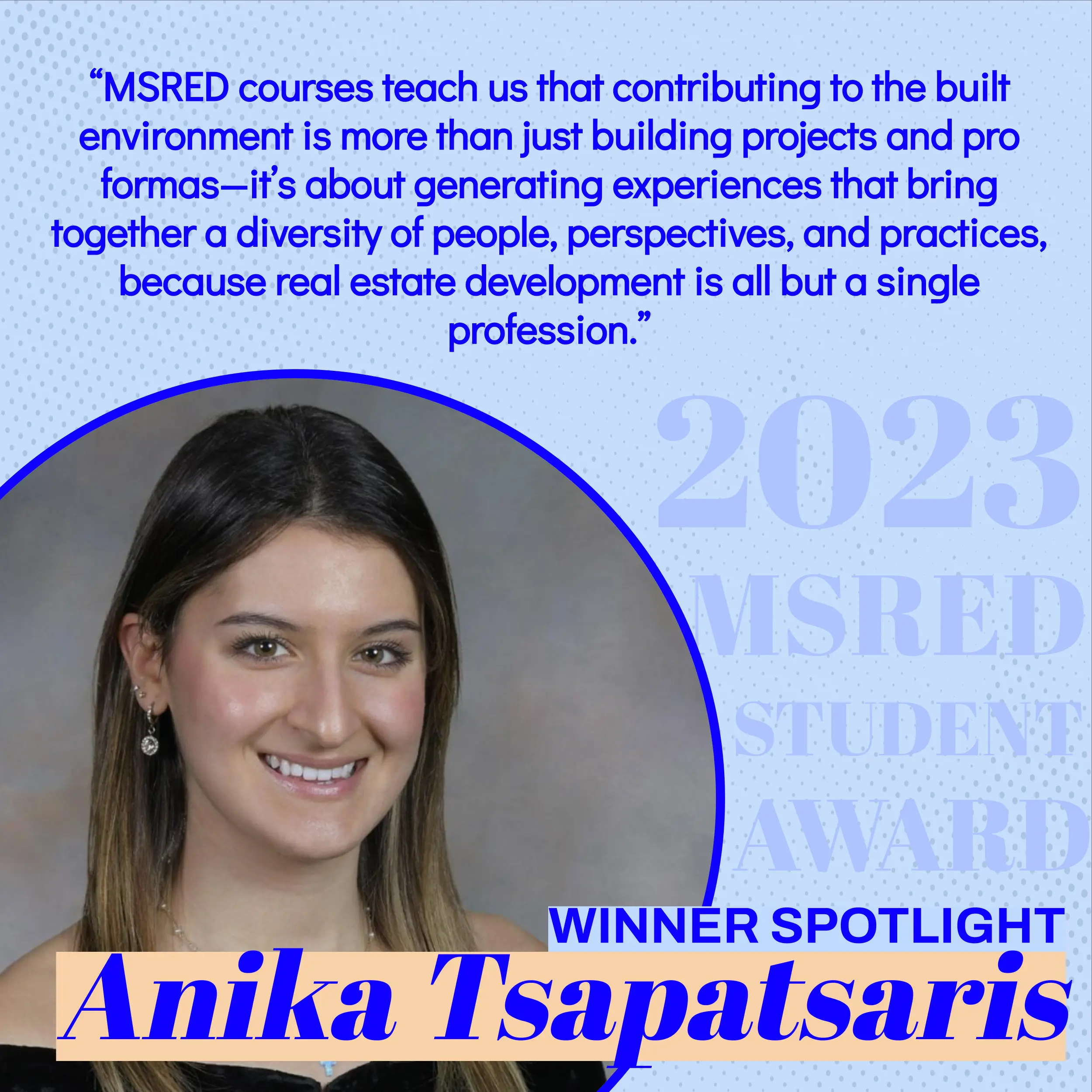
Anika Tsapatsaris
Degrees: Master of Architecture and Master of Science in Real Estate Development
Graduation Date: Expected December 2025
1. Reflecting on your time in the MSRED program thus far, what are the key lessons or experiences that have had a lasting impact on your professional and/or personal growth?
If you love it, lead it. Leadership goes a long way: Your year in the MSRED program (or four, if you’re a dual degree) is a rare time in your life when you are surrounded by people with similar passions but different ways of approaching them, and by placing yourself in a position where you must listen and respond to—and oftentimes navigate discrepancies between—these approaches, you become a more versatile thinker. As important as consistency and stability are in leadership, perhaps most important are adaptability and flexibility, because you can’t learn something new by trying something old. By the time I graduate from the MSRED program in December of 2025, I’ll have spent eight years at Columbia University—but I can confidently say that the two years I’ve spent in the MSRED program thus far have generated the most personal and professional growth I have experienced since I joined Columbia as a teenager in 2018. From serving as this year’s GSAPP Student Council President, MSRED Class President, and last year’s MSRED Class Secretary, to serving as a Teaching Assistant for four different MSRED professors, to working in the MSRED office as a Program Assistant (as campus tour guide, conference-planner, flier-maker, website-editor, and Gateway job-poster—it can all be done), I have learned that I am most productive when I am most involved, and when I lead the things I love.
2. What academic areas of focus have you explored while in the MSRED program? Have these led to a greater understanding of your future professional goals?
Having joined the MSRED program from a non-finance background (and having received my undergraduate degree from Columbia only ten days before my first day at GSAPP), I have been truly fascinated and encouraged by how creative and conceptual finance can be. With my recently-granted Bachelor of Arts in Architecture, I thought that I had studied the most imaginative discipline; however, upon beginning my finance courses at GSAPP, I quickly came to realize that finance, too, can be a highly inventive act, and designing a financial model requires just as much detail-orientedness as does designing a building. GSAPP has provided me the opportunity to explore the nexus between design and development, and to synthesize the meticulousness and relentless diligence of an architect with the communicational and leadership skills of a real estate developer. Understanding both architecture and finance as simultaneously inventive and technical endeavors, which require creativity as much as they do critical thinking, I look forward to developing the skills I have acquired at GSAPP throughout the rest of my time as a student and into my professional career.
3. How do you plan to utilize your time in the MSRED program to contribute to the world, post-graduation?
Our MSRED courses teach us that contributing to the built environment is more than just building projects and pro formas—it’s about generating experiences that bring together a diversity of people, perspectives, and practices, because real estate development is all but a single profession. It is rather the coordination of every component that comprises our built, technological, and ecological environments, all with the goal of leaving the world a better place than we found it. GSAPP, the MSRED program, and the MSRED Alumni Inc.’s commitment to celebrating and advancing interdisciplinarity has prepared us to be sharp, sensitive thinkers, and granted us the confidence to not only know enough about everything, but to also be able to execute just about anything.
4. What is a core memory from your time in the MSRED program, either academic or social?
Last year, I had the honor of co-organizing the 2023 MSRED Conference (“Armageddon or Nirvana: The Real Estate Context of 2023”) with Rebecca Andersen Polimeda. To see the title boards, run of show, program, and AV slides at conference-scale after tedious months of laptop-size production was nothing short of tear-jerking—especially when Rebecca and I noticed the typo on the very last AV slide of the day, which wrote that Marc Holliday and Anthony Scaramucci, who were already on stage for their afternoon fireside chat, were to speak from 2:35 pm to 2:40 pm (that was a different kind of tear-jerking). Most importantly, this experience gave me the opportunity to work closely and engage with the leaders of our program—from Patrice, Jessica, Rebecca, and Thelma, who lead the charge on campus, to the plethora of alumni who continue to drive the MSRED community in the professional world and inspire young alumni through their admirable accomplishments.
5. What is one piece of advice you would give a future MSRED student?
Own what you don’t know. Students join the MSRED program from a wide range of backgrounds, and you could be a (near) expert on one topic and have never heard about another. You are not supposed to find every class easy—or even intuitive—but the beauty in the challenge of learning something new is that you become better at what you were “good” at by understanding what you weren’t so good at. Don’t be afraid to ask questions: If you don’t ask, the answer is already “no.” The purpose of the MSRED program is to make you a more multidisciplinary, inter-intuitive individual, because only by developing your own unknowns will you discover and fit into real estate’s hybrid environment. (And as Patrice once said, “Real estate isn’t rocket science. Even rocket science isn’t rocket science.”)
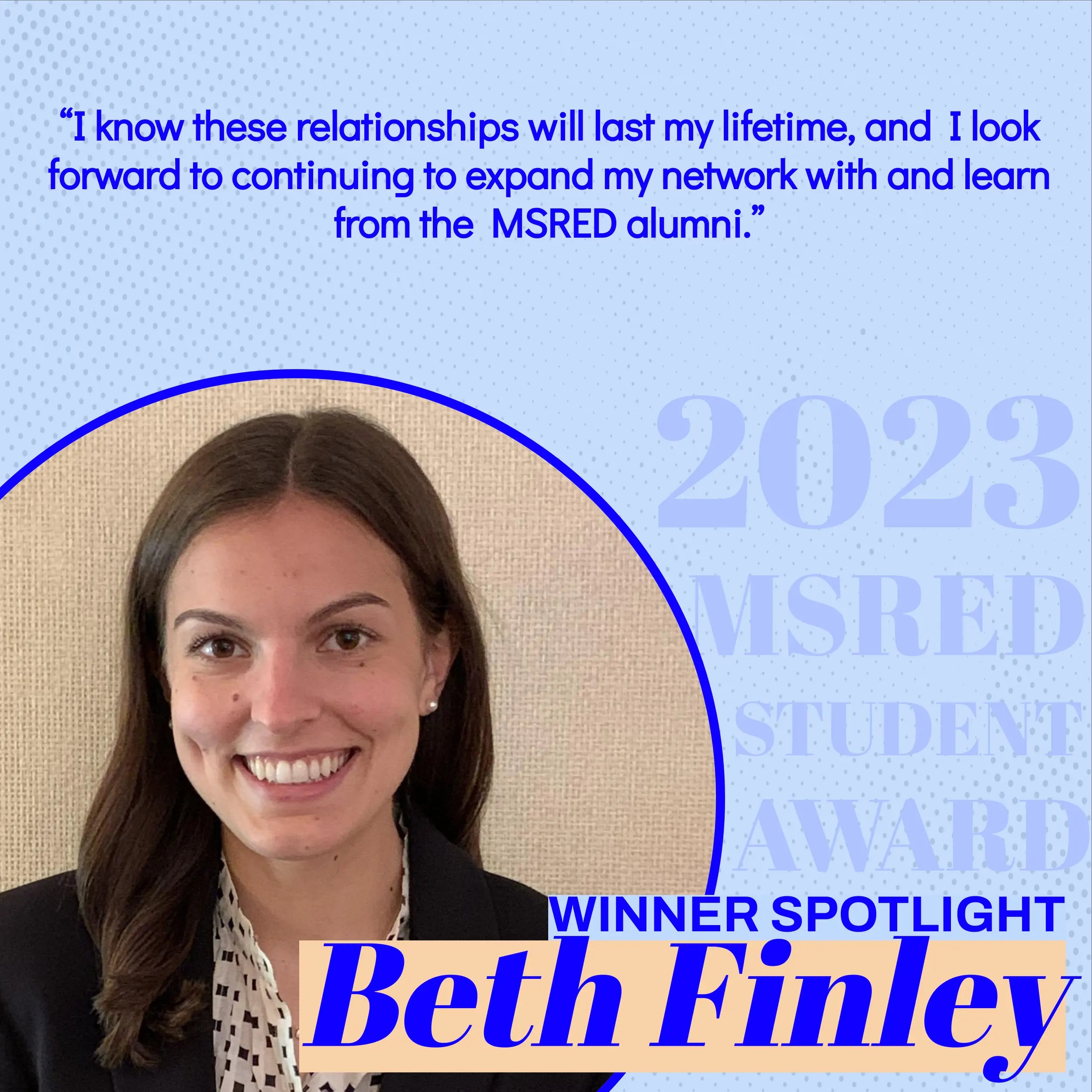
Beth Finley
Degree: Master of Science in Real Estate Development
Graduation Date: Expected May 2024
1. Reflecting on your time in the MSRED program thus far, what are the key lessons or experiences that have had a lasting impact on your professional and/or personal growth?
Our MSRED program’s unique commitment of being a full-time student has been extremely valuable for my learning experience and growth. It was an aspect that really drew me to the program when I was initially applying, and now I am even more grateful that I have had the opportunity to become very close with my classmates and expand my network so much farther than I thought was possible. After being in Wood for our core lectures almost every day last summer, I was able to quickly become acquainted with many of my classmates. The friendships with my classmates and mentorships with my professors are so valuable and have really flourished in our tight-knit environment. I know these relationships will last my lifetime, and I look forward to continuing to expand my network with and learn from the MSRED alumni.
2. What academic areas of focus have you explored while in the MSRED program? Have these led to a greater understanding of your future professional goals?
Throughout the program I have been able to take courses that appeal to both my interest in architectural design and my desire to build upon my recent professional experience. This hybrid concentration has allowed me to take deeper dives into financial analyses, like learning about fund management and underwriting potential acquisitions, while also exploring entirely new areas, like hotel development and building repositioning. I feel well-prepared to take on a professional development role that could cover a variety of responsibilities dependent on the market cycle, whether it be acquisitions and investments, asset management or capital raising.
3. How do you plan to utilize your time in the MSRED program to contribute to the world, post-graduation?
The valuable knowledge, skills and lessons that I have learned during the program make me very excited about my future in the real estate industry. Development is incredibly transformative – I have always been amazed at how a parking lot is turned into a 300-unit building that people can call a home with ground floor retail that reactivates an entire city block. I value placemaking and want to work on mixed-use developments that create a larger, vibrant community. Many of our development classes have emphasized the importance of thoroughly studying the target market and understanding the user’s priorities, and I aspire to add value to the surrounding community and create people-first neighborhoods within any development I work on.
4. What is a core memory from your time in the MSRED program, either academic or social?
My favorite memory is the final presentation day for our Development Process course last summer. The summer session was intensive, and for many of us this was the first time we had worked on a development proposal. My team worked particularly well together, and we dedicated a lot of time and thought to our final presentation. I was very proud of our final product, and it was extremely rewarding to see where we had started the semester with barely any knowledge on development in New York City to creating clean and concise materials for our proposal of a residential rental development in Chelsea. From the zoning and market analysis to modeling the cash flows and thinking through the program stack, we created a comprehensive presentation. After presenting our work, we celebrated in the Avery basement with prosecco – a fond moment I will never forget!
5. What is one piece of advice you would give a future MSRED student?
Always attend the MSRED guest lecture events! Our program does an amazing job of inviting very accomplished professionals from a variety of backgrounds in real estate to share their perspective on the market and anecdotes about their careers. I have gained valuable nuggets of wisdom from each lecture that will be applicable to any future career, and their presentations have introduced us to so many new, exciting areas in real estate, like office to residential conversions, large-scale television studio developments and ground-breaking supertalls.
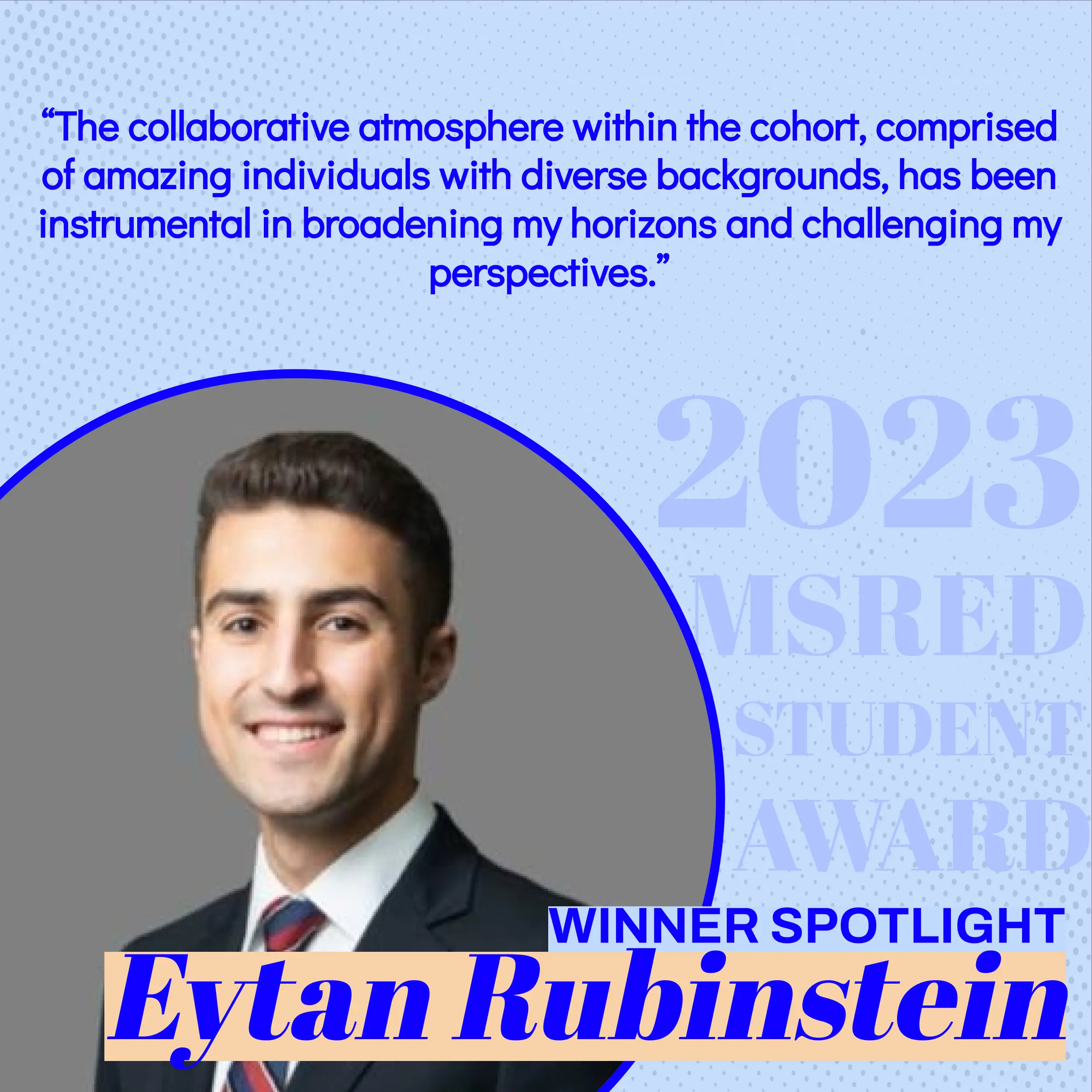
Eytan Rubinstein
Degree: Master of Science in Real Estate Development
Graduation Date: Expected May 2024
1. Reflecting on your time in the MSRED program thus far, what are the key lessons or experiences that have had a lasting impact on your professional and/or personal growth?
One of my biggest takeaways from the MSRED program has been a deeper appreciation for the many pieces of the puzzle that constitute real estate and how crucial it is to understand the functions and interconnected nature. Throughout the program, I've had the opportunity to think like a site planner, architect, lender, asset manager, portfolio manager, developer, entrepreneur, lawyer, and more. The collaborative atmosphere within the cohort, comprised of amazing individuals with diverse backgrounds, has been instrumental in broadening my horizons and challenging my perspectives. Although the program has often pushed me out of my comfort zone, the experience of wearing different hats and engaging in insightful discussions has not only made me more well-rounded but has also better equipped me with the knowledge and skills to become a player within the dynamic realm of real estate.
2. What academic areas of focus have you explored while in the MSRED program? Have these led to a greater understanding of your future professional goals?
During my time in the MSRED program, I have actively pursued a comprehensive education, working both to enhance my strengths and to add new proficiencies in areas that were previously less familiar. However, among these, one area in particular I explored further was adaptive reuse. Initially drawn to learning about value-add opportunities, my curiosity naturally led me to delve into the realm of adaptive reuse. To deepen my understanding, I launched the Repositioning & Adaptive Reuse Club, providing a platform to host guest speakers, visit exciting adaptive reuse projects across the city, and learn from peers who had worked on adaptive reuse projects before joining the MSRED program. Complementing club activities, I enrolled in elective courses specifically dedicated to adaptive reuse and building repositioning. While it is still to be determined whether my future work will be in the adaptive reuse space, the learning experience in the MSRED program has undoubtedly transformed my perspective on the existing built environment, fostering a mindset that encourages thinking outside the box even when the “box” has well-defined parameters.
3. How do you plan to utilize your time in the MSRED program to contribute to the world, post-graduation?
The MSRED program has undoubtedly made me a more thoughtful individual, placing greater emphasis on a broader set of stakeholders when evaluating the world of real estate. However, I don't approach real estate with purely altruistic intentions; instead, I see real estate investors and developers as problem solvers with the potential to be part of the solution while creating and realizing significant value. Real estate, however, is not a solitary effort. I anticipate the friendships formed with classmates and connections within the alumni community will lead to numerous collaborations and partnerships as we strive to create value for ourselves and our many stakeholders.
4. What is a core memory from your time in the MSRED program, either academic or social?
A core memory from my time in the MSRED program is definitely the site visits with my peers. There is something special about witnessing the development and evolution of real estate firsthand while also having the opportunity to interact directly with the industry stakeholders. These experiences make classroom learnings all the more tangible. Among the various site visits, my favorite was the tour of the Hudson Hotel conversion into coliving apartments, organized by the Repositioning & Adaptive Reuse Club. Exploring the building's history, which is tied to notable figures like JP Morgan's daughter and Ian Schrager, learning about the overall investment strategy, and hearing from the developer about the many ways they planned to maximize value, was as fascinating as it was memorable.
5. What is one piece of advice you would give a future MSRED student?
Approach the MSRED program like a sponge – absorb everything. Be open to learning about all verticals within real estate, take classes in areas you know nothing about, attend as many site visits and guest lectures as your schedule allows, and learn from your classmates – they can sometimes be the best sources of knowledge!